Why Low Performers Become Top Performers at Other Companies
- Dexterous
- Apr 21
- 8 min read
Updated: 3 days ago
The environment your people work in matters more than the people themselves. Here is the proof.
You have probably seen it happen.
Someone gets managed out. Leadership quietly agrees they were never the right fit. The team moves on. And then, a year later, you hear through the grapevine that the same person is thriving somewhere else. Promoted. Crushing their numbers. Winning awards.
It is one of the most common and least examined patterns in business: low performers at one company become top performers at another. And everyone who wrote them off asks the same confused question: how?
The answer is uncomfortable. It was never really about them.
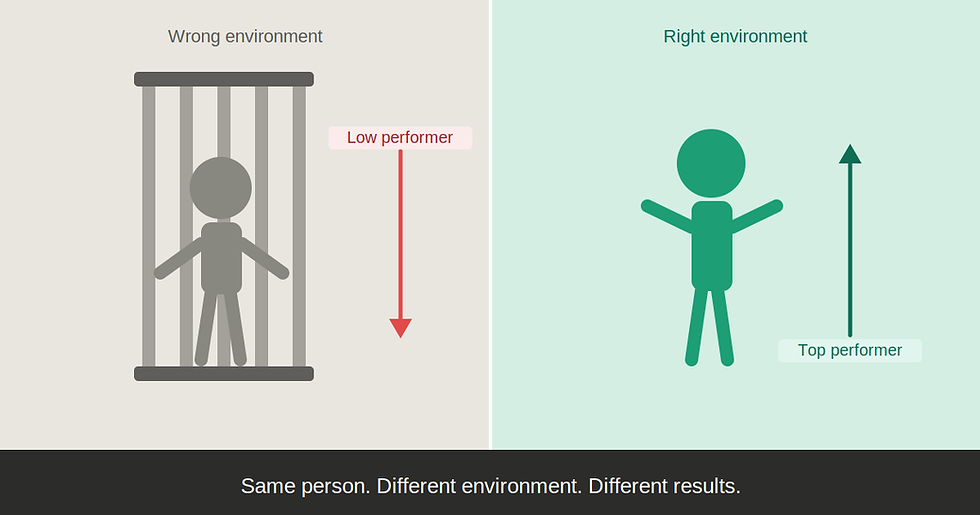
Research, organizational psychology, and some of the most compelling case studies in business history point to the same conclusion: in most cases of persistent underperformance, the environment is the primary variable. Not the person. The system they operate in determines what they are capable of producing.
In the Payments and FinTech world this matters more than most people want to admit.
The NUMMI Case Study: The Same Workers, Completely Different Results
In 1982, General Motors shut down its Fremont, California assembly plant. By nearly every measure, it was the worst-performing facility in the GM network.
Absenteeism ran above 20%. Workers filed thousands of grievances. Vehicles rolled off the line full of defects. Workers later admitted to deliberate sabotage: hiding bottles inside door panels, scratching paint, installing parts incorrectly on purpose. The plant had become a war zone between labor and management.
GM's conclusion was straightforward. These were bad workers.
In 1984, the same plant reopened as a joint venture between GM and Toyota called New United Motor Manufacturing, Inc. (NUMMI). Toyota ran operations. And in a move that baffled many at the time, they hired back approximately 85% of the original Fremont workforce. The same people. The ones GM had declared unfixable. (Lean Enterprise Institute)
Within a few years, NUMMI was producing vehicles that rivaled the quality of Toyota's best Japanese plants. Absenteeism nearly disappeared. The sabotage stopped entirely. Workers were engaged, motivated, and proud of what they built.
Nothing about the workers had changed. Everything about the system around them had.
Toyota introduced the Toyota Production System, a management philosophy built on a few core beliefs: workers are experts in their own jobs, problems should be surfaced not buried, and managers exist to support work rather than police it. Workers were given the authority to stop the production line the moment they spotted a defect. Under the old GM system, stopping the line meant disciplinary action. Under Toyota, it meant doing your job well.
The Fremont workers were never bad employees. They were rational people responding to a system that punished initiative, rewarded disengagement, and made caring about quality feel pointless. When the system changed, so did everything else.
That is the NUMMI lesson. And it applies far beyond a California assembly plant.
Why the Same Person Produces Different Results in Different Environments
If the same workforce can go from the worst in a company to matching world-class standards without changing who they are, the question becomes: what exactly is the environment doing?
Clarity of purpose. People perform better when they understand not just what to do, but why it matters. Vague goals, shifting priorities, and metrics that feel disconnected from real outcomes quietly destroy output quality regardless of how capable or motivated someone is. At NUMMI, workers could see and name the cost of a defect. The work had visible stakes.
Feedback and information access. High-performing environments give people fast, relevant signals about whether their actions are working. Dysfunctional ones withhold that information, or deliver it so late it is useless. Without feedback, improvement is impossible. The system is blocking learning before it can start.
Psychological safety. Harvard Business School researcher Amy Edmondson has spent decades documenting this: teams perform significantly better when people feel safe raising problems and admitting mistakes without fear of punishment. The original GM Fremont plant was a place where speaking up was dangerous. NUMMI became one of the most studied examples of what psychological safety looks like in practice. (MIT Sloan Management Review) Workers stopped the line. Workers flagged defects. The difference was that the consequences of honesty were positive rather than punitive.
Autonomy and proximity to decisions. When the people closest to the work have no authority to act on what they observe, accountability collapses. Rigid hierarchies and layers of approval do not create accountability. They make it impossible. People who cannot act on problems eventually stop noticing them. Disengagement is not a character flaw. It is a logical response to powerlessness.
What management models. Leadership behavior is not background noise. It is the loudest signal in any organization. When leaders model blame, risk avoidance, and short-termism, those patterns reproduce at every level. When they model transparency, curiosity, and accountability, those patterns reproduce too. The culture of an organization is largely a reflection of what its managers do and what they reward.
How the work is structured. Processes, handoffs, team design, and performance measurement either enable good work or obstruct it. A well-designed process makes it easy for capable people to deliver. A broken one defeats them. Talented people in a dysfunctional structure will spend most of their energy navigating the dysfunction rather than doing the actual work.
Why Low Performers Become Top Performers Somewhere Else
This is the pattern that organizations rarely talk about openly, even though most people have seen it.
An employee carries a reputation as a low performer. They miss targets. Their engagement is low. Management has written them off. Then they leave, and six months later someone mentions that they are doing exceptional work at their new company.
The reason is straightforward: the label "low performer" is relational. It does not describe a fixed property of a person. It describes what one specific person produced inside one specific environment, under one specific style of management, measured against one specific set of expectations. Change enough of those variables, and the label no longer applies.
A person who is energized by autonomy and ambiguous problems will look like a low performer inside a tightly supervised, heavily process-driven role. Put them in a startup or an innovation team where ownership is expected, and they become a standout. A systematic, detail-oriented thinker will seem slow and overly cautious in a fast-moving sales environment. Put them in compliance, quality assurance, or technical documentation, and they become indispensable. A direct communicator will be labeled as difficult in a conflict-avoidant culture and as a breath of fresh air in one that prizes straight talk.
The NUMMI case makes this argument at scale. Thousands of workers who had been defined as a failing workforce became a world-class one. Not because of training programs or motivational speeches. Because the conditions that made good work possible were finally present.
The more common management instinct is to treat low performance as a stable trait. Something the person has, like a flaw in their character or a missing skill no environment can compensate for. But the evidence does not support that conclusion. The evidence supports a different and more demanding one: most labeled underperformers are capable people who have not yet been given the environment that matches how they work best.
How to Tell When the System Is the Real Problem
Most organizations are reluctant to examine their own systems as a source of performance failure. Systems are built by leaders, and leaders are not naturally inclined to conclude that their own design decisions are producing the outcomes they are frustrated by. Blaming the people is easier. But there are reliable signals that the system is the primary driver of poor results.
The problem moves with the role, not the person. If every person who steps into a specific position struggles, and those same individuals perform well when they move elsewhere, the role and its surrounding structure are what need to change.
Strong outside hires disappoint consistently. When a company repeatedly brings in well-regarded people from other organizations and they underperform, the hiring process is rarely the issue. The more productive question is what the environment is doing to those people after they arrive. Capable people do not usually become incapable ones without a contributing cause.
The same person performs differently under different managers. This is one of the clearest natural experiments that exists inside organizations. When the same employee excels under one manager and struggles under another without the role itself changing, the management approach is the variable. This is routinely misread as a people problem when it is plainly a leadership one.
Workarounds become the real way work gets done. When employees routinely bypass official processes, route around broken systems, and rely on personal relationships to accomplish what the structure should enable, the official system has failed. The organization is surviving in spite of its processes.
Certain groups leave at higher rates. If an organization consistently loses high performers, early-career employees, or people from specific demographic groups, the environment is failing those populations. Turnover is data. Most organizations do not treat it seriously enough.
Low engagement that survives leadership changes. When engagement scores are persistently low and do not improve when new people join or new leaders arrive, the problem is structural. It has outlasted the individuals who were supposedly causing it. That is about as clear a systemic signal as exists.
What This Means for Leaders
None of this is comfortable to sit with. If the environment is a primary driver of performance, then leaders are responsible for a significant portion of the outcomes they are trying to solve. The underperformance that is most frustrating to them is, in many cases, a downstream result of the systems and conditions they have built.
That demands a different set of questions when things go wrong. Not who failed, but what made it likely they would fail? Not why aren't people performing, but what in this environment is working against performance? Not how do we move this person out, but what would need to change for this person to succeed here?
Toyota asked those questions at NUMMI. They looked at a workforce that another company had completely given up on and decided to build a system worthy of what those workers could do. The results were not a surprise to anyone who understands how organizations actually work. They were a logical outcome of building conditions where good work was possible.
The workers were never the problem. They were responding to the environment built around them.
The Most Important Conclusion: Today's Low Performer Is Someone Else's Top Performer
The person your organization labeled a low performer and showed the door did not stop existing. They went somewhere else. And in many cases, far more than any of us track or want to admit, they became exceptional there.
Not because they changed. Because the environment did.
The label "low performer" is not a verdict on someone's potential. It is a record of what one person was able to produce inside one specific system, managed one specific way, held to one specific set of standards. Change the system, change the manager, change the structure, and you often get a completely different result from the exact same person.
Somewhere right now, someone who was written off at your organization is being another company's best hire. They are hitting targets they were never set up to hit before. Their ideas are landing. Their strengths are finally in play. They are being recognized for the exact qualities that their last environment either failed to see or actively suppressed.
That is not a feel-good story. It is a direct challenge to how quickly and how confidently organizations label people as lost causes based on performance inside a single, often broken, context.
The most honest question any leader can ask is not whether someone was a low performer. It is whether the environment ever gave them a real chance to be anything else.
If the answer is no, the performance was never really theirs to own.
At Dexterous, we know the payments space is small. Back channeling is common, and when a hiring manager goes to their network for a reference on a candidate who was laid off, let go, or walked away from a bad situation, the story they hear is almost always told from the perspective of one environment. One manager. One culture. One set of conditions that may have had nothing to do with what that person is actually capable of.
As a boutique executive search firm specializing in Payments and FinTech, we spend our time getting to know both sides of that question deeply. We know the companies, the cultures, and the leadership styles that make certain profiles thrive. And we know the candidates well enough to place them where they will not just perform, but excel.
The person your competitors wrote off might be exactly who you are looking for. And the right environment might be yours.
Get in touch with Dexterous to find the talent that will thrive in your environment, or to find the environment where you will do your best work.